Introduction
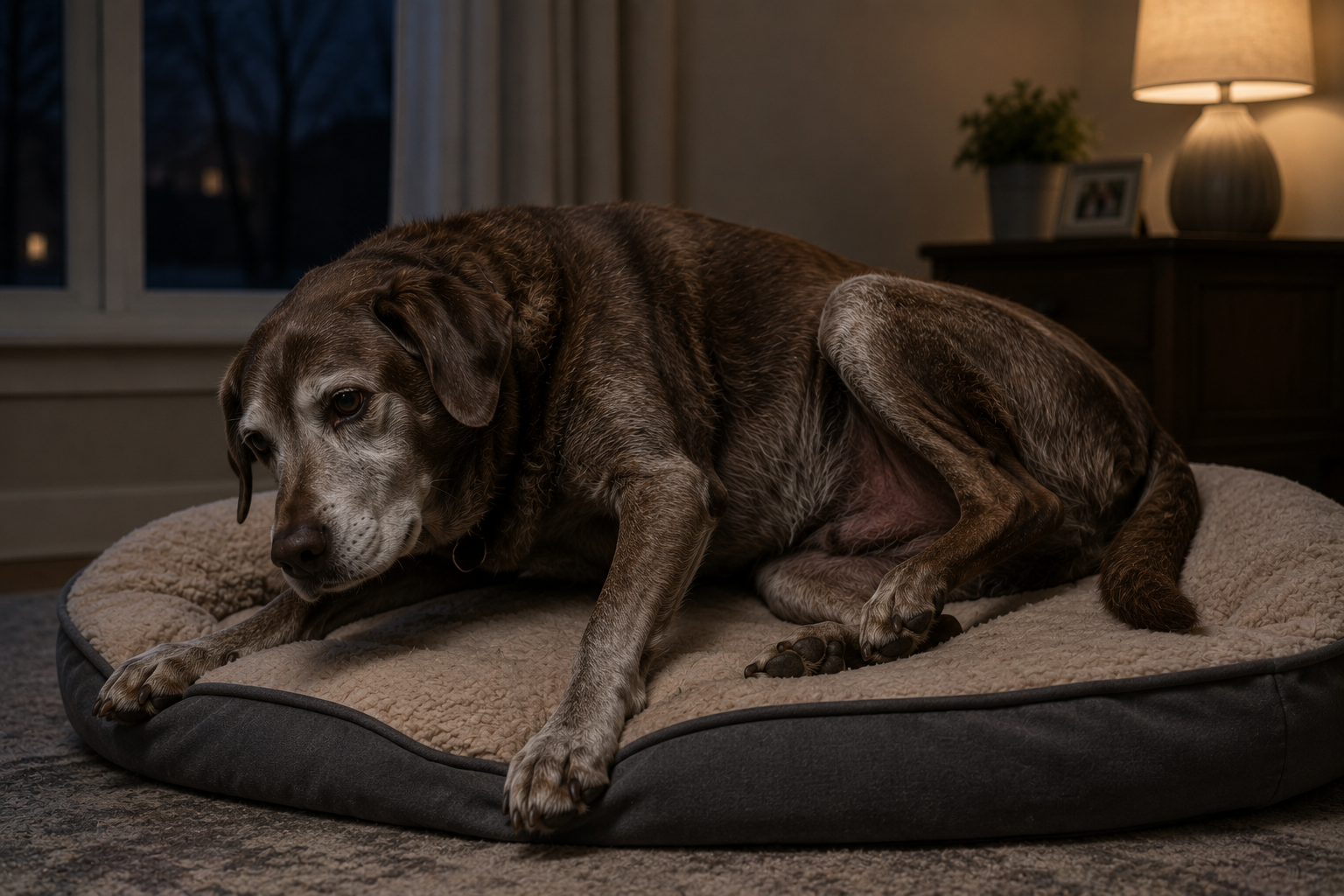
Your dog won’t settle at night, it’s one of those problems that owners handle by adapting around it rather than solving it. The dog paces or whines, so it gets let into the bedroom. Or it gets ignored until eventually it stops, which works some nights and not others. Neither approach fixes anything. The dog still does not settle reliably, and the owner loses sleep either way.
My own experience was different in cause but familiar in pattern. On nights with thunder or strong wind, my dog became restless and there was no quick fix. You just wait it out. But for owners dealing with this every night without an obvious external cause, waiting it out is not a strategy. There is a reason the dog is not settling, and most of the time that reason is identifiable and fixable.
This article covers the most common causes of a dog that won’t settle at night and what you can do about each one.
By Dogcat-Care.
Table of Contents
Why Dogs Struggle to Settle at Night
Before looking at specific causes, it helps to understand what settling at night actually requires from a dog. Settling is not passive. It is an active neurological process. The dog’s nervous system needs to move from an alert, stimulated state into a calm, restful one. That transition depends on several things going right: the dog needs to be physically tired but not overstimulated, it needs to feel safe and comfortable in its environment, and it needs to have no unresolved physical discomfort or anxiety driving it to stay alert.
When any of those conditions are not met, the dog stays activated. Pacing, whining, repositioning repeatedly, barking at sounds, seeking contact with the owner. These are not deliberate behaviours. They are the dog’s nervous system staying in a state it cannot move out of.
The most common mistake owners make is treating the nighttime behaviour as the problem. The nighttime behaviour is the symptom. The cause sits earlier in the day, or in the dog’s physical health, or in the sleeping environment. Addressing the symptom without the cause produces inconsistent results at best.
Cause 1: Not Enough Physical Exercise During the Day
The most straightforward cause of a dog that won’t settle at night is a dog that has not used enough physical energy during the day. An under-exercised dog arrives at bedtime with a nervous system that is still running at higher activation than rest requires.
This is especially common in higher-energy breeds. Border Collies, Huskies, Vizslas, Labradors and similar dogs have energy reserves that a 20-minute walk does not come close to depleting. An owner who has had a long day and gives the dog a short evening walk is not neglecting it intentionally. But the dog’s body does not adjust its energy output based on the owner’s schedule. It still has energy to burn.
The fix is straightforward but requires consistency. More daily movement, distributed across the day rather than front-loaded in one session. A walk in the morning and one in the evening consistently produces better nighttime settling than one long weekend walk and several short weekday ones. For guidance on how much exercise different dogs actually need, the article on how often you should walk your dog breaks this down by size and breed.
One important nuance: mental exhaustion contributes to settling as much as physical exhaustion. A dog that has had a training session, worked a puzzle feeder, or done scent work during the day is often easier to settle at night than one that has only walked. Mental effort burns energy in a way that physical exercise alone does not fully replicate.

Cause 2: Overstimulation Late in the Evening
This cause is the opposite of what most owners expect. A dog that won’t settle at night is often assumed to need more activity before bed. In reality, stimulation close to bedtime can delay settling significantly.
High-intensity play, rough games, or exciting interaction in the hour before the owner wants the dog to sleep raises arousal levels rather than depleting them. The dog’s nervous system does not switch from highly stimulated to settled within minutes. It needs a wind-down period. An owner who plays an enthusiastic fetch session at 9pm and then expects the dog to be asleep by 10pm is working against the dog’s neurological reality.
The practical adjustment is to move high-intensity activity earlier in the evening and establish a consistent, calm wind-down routine in the hour before bed. Lower the lights. Reduce noise and household activity. Give the dog access to its sleeping area. Some dogs benefit from a short, calm sniff walk in the evening rather than a stimulating play session. The goal is to give the nervous system time to come down from the day before asking it to rest.
Cause 3: Anxiety and Separation-Related Distress
Anxiety is one of the most common causes of a dog that won’t settle at night, and it is the cause that owners most often misread as stubbornness or attention-seeking.
A dog with generalised anxiety or separation-related distress experiences being alone at night as genuinely threatening. The nighttime environment removes the social proximity that makes the dog feel safe. In response, the dog stays alert, vocalises, paces, or seeks the owner because those behaviours have historically resulted in contact or reassurance.
The owner who lets the dog into the bedroom because the whining is unbearable is not making a mistake in terms of kindness. But it does reinforce that night-time distress is the strategy that produces contact, which makes the underlying pattern harder to address.
Anxiety-driven nighttime restlessness is usually accompanied by other signs during the day: clinginess, following the owner between rooms, difficulty settling when the owner is present but not paying attention, or distress when the owner leaves the house. If these daytime patterns are present alongside the nighttime restlessness, anxiety is likely a significant factor.
Addressing anxiety-driven nighttime problems requires working on the anxiety itself, not just managing the nighttime behaviour. For a broader framework of how to approach anxiety in dogs, the guide on how to calm an anxious dog covers the evidence-based approaches in detail. For dogs whose anxiety is specifically linked to being separated from the owner, the article on dog separation anxiety addresses the specific patterns and how to work through them.
Cause 4: Physical Discomfort or Pain
A dog that won’t settle at night because of physical discomfort is often one of the hardest causes for owners to identify, because dogs do not reliably communicate pain. They may lie down, shift position repeatedly, get up, circle, and lie down again. Owners read this as restlessness without recognising that repositioning is often a pain response.
Joint pain is particularly relevant at night because lying in one position for an extended period stiffens painful joints. A dog with developing arthritis that goes undiagnosed may be genuinely uncomfortable on its sleeping surface and unable to find a position that does not cause low-level pain. The dog is not misbehaving. It is trying to manage physical discomfort with the only tools available to it.
Other sources of nighttime physical discomfort include gastrointestinal issues, which can cause cramping and restlessness that owners attribute to behaviour rather than digestion, dental pain, skin irritation from allergies, and ear infections, which can worsen when the dog lies down and the ear canal position changes.
If a dog has been recently unsettled at night without a clear behavioural explanation, particularly if it is middle-aged or older, a veterinary check to rule out physical causes is the appropriate first step before attempting any behavioural intervention.
Cause 5: The Sleeping Environment Is Wrong
An uncomfortable or insecure sleeping environment is a frequently overlooked cause of a dog that won’t settle at night. Owners focus on what the dog is doing without examining where the dog is being asked to sleep and whether that environment actually supports rest.
Temperature. Dogs are sensitive to temperature in both directions. A sleeping area that is too hot or too cold disrupts rest. This is particularly relevant for short-coated breeds in cold environments and thick-coated breeds in warm ones. The sleeping area should be at a comfortable, consistent temperature and away from direct drafts or heat sources.
The sleeping surface. A thin mat or worn-out bed provides inadequate cushioning for a dog that sleeps for 12 to 14 hours per day. The physical pressure on joints, elbows, and hips from an inadequate surface accumulates over hours and disrupts sleep quality even without clinical joint disease. A well-supported sleeping surface is not a luxury. It is a basic requirement for uninterrupted rest. For a comparison of what to look for in dog beds, the article on best dog beds covers the options across different sizes and budgets.
Location. Dogs are social sleepers by nature. A dog placed in a room far from the rest of the household may find the isolation genuinely distressing, particularly if it has not been gradually accustomed to sleeping alone. Moving the sleeping area closer to where the family sleeps, even outside the bedroom door, often reduces nighttime restlessness significantly without requiring the dog to share the bed.
External noise and light. Dogs hear and detect movement at ranges humans do not. Traffic, neighbours, animals outside, and sounds from elsewhere in the house can keep a dog in a state of low alert that prevents deep sleep. A consistent background sound, a fan or a white noise source, can mask intermittent external sounds and reduce the frequency with which the dog is pulled out of rest by stimuli it cannot ignore.

Cause 6: Disrupted Routine or Recent Change
Dogs orient themselves through routine. A consistent daily schedule of feeding, walking, rest, and social interaction gives the dog a predictable framework that supports the transition into sleep at the end of the day.
When that routine is disrupted, even by changes that seem minor to a human, the dog loses the reliable cues that normally signal the end of the day. A new work schedule, a change in feeding time, a new person in the house, furniture rearranged, a holiday, or even a change in what the owner does in the evenings can destabilise a dog’s sense of when rest time begins.
This type of restlessness is typically temporary. As the dog adapts to the new pattern and the new routine becomes consistent, the nighttime settling improves. The owner’s job during this period is to establish the new routine as consistently as possible and avoid varying it further while the dog adjusts.
Cause 7: Age-Related Changes
Puppies and older dogs have sleep patterns that differ from those of healthy adult dogs in ways that owners need to understand.
Puppies have not yet developed the capacity for extended uninterrupted sleep. Young puppies sleep in shorter cycles and wake more frequently. They also have smaller bladders and need to eliminate more often overnight, which creates genuine physical need rather than behavioural preference. Expecting a puppy under four months to sleep through the night without waking is expecting something the puppy is not yet physiologically capable of. The solution is management: nighttime toilet trips, a crate or enclosed sleeping area positioned close to the owner, and gradual extension of the intervals between wake-ups as the puppy matures.
Older dogs can develop nighttime restlessness as a result of cognitive dysfunction, the dog equivalent of dementia, which disrupts the normal sleep-wake cycle. A dog that was previously a reliable overnight sleeper and begins pacing, vocalising, or becoming disoriented at night in its senior years may be showing early signs of cognitive decline. This pattern is worth discussing with a veterinarian, as there are dietary and medical interventions that can slow progression and improve sleep quality.
Pain, as discussed above, also becomes increasingly relevant as dogs age. A dog that settled reliably at seven and begins struggling at ten is more likely experiencing physical discomfort than a behavioural regression.
What Actually Helps: Practical Steps
Once you have a sense of which cause or combination of causes is most likely, the interventions follow logically. These are the changes that produce the most consistent improvement.
Establish a consistent evening wind-down routine. Same time each evening, same sequence. A calm walk, then feeding, then quiet time in the sleeping area. The consistency is the mechanism. The dog learns the sequence and begins anticipating rest at the point in the routine where rest normally follows.
Move high-intensity activity earlier. Energetic play and training before 7pm rather than in the hour before bed. The dog has time to come down from stimulation before the settling period begins.
Assess and improve the sleeping setup. Check the surface, the temperature, the location, and the noise environment. Make changes systematically rather than all at once so you can identify what actually made the difference.
Address exercise deficits consistently. Not one long walk when you have time, but consistent daily movement that matches the dog’s actual energy needs. Two walks per day, every day, produces better settling than variable activity levels.
Do not reinforce the nighttime behaviour with inconsistent responses. The owner who sometimes lets the dog into the bedroom when the whining becomes too much, but other nights holds out, is teaching the dog that persistence eventually works. Inconsistency extends the problem significantly. Whatever the rule is, apply it consistently.
Consider calming support where appropriate. For anxiety-driven restlessness, certain supplements including L-theanine, melatonin, and adaptogenic compounds have evidence supporting their use in reducing baseline anxiety in dogs. These are not quick fixes and work best alongside behavioural and environmental change rather than instead of it.
Rule out physical causes first. If the restlessness is new, unexplained by any recent change, and accompanied by other physical signs, a veterinary visit before attempting any behavioural intervention saves time and addresses the actual cause rather than the symptom.
The Bedroom Question
Many owners end up with their dog sleeping in the bedroom or on the bed because it is the path of least resistance when the dog won’t settle at night. Whether this is a problem depends entirely on whether it works for the household and whether it is a choice rather than a concession to the dog’s distress.
A dog sleeping in the bedroom by design, in a comfortable bed in a consistent location, is a valid arrangement that works well for many owners. A dog that has trained the owner into allowing it by escalating its nighttime behaviour until the owner gives in is a different situation. The first is a preference. The second is a pattern that will repeat and escalate as long as the escalation continues to produce the desired outcome.
If the bedroom arrangement is causing disrupted sleep for the owner or is not sustainable, addressing it requires establishing an alternative sleeping location the dog is comfortable in, and then holding that boundary consistently even through the period of initial protest.
FAQ
Why does my dog only pace at night and not during the day?
Nighttime removes the daytime stimulation and social activity that keeps a dog engaged and distracted. Any underlying anxiety, physical discomfort, or excess energy that was manageable during the day becomes more noticeable when the environment quiets down and there is nothing to redirect the dog’s attention. Nighttime is when unresolved causes surface most clearly.
My dog sleeps fine at the weekend but not on weekdays. What causes this?
The most likely explanation is a difference in the dog’s daily activity level. Weekend walks are often longer and more varied. Weekday walks may be shorter due to work schedules. The dog arrives at bedtime on weekdays with more unspent energy. Increasing weekday exercise, even by adding a second shorter walk, often resolves this pattern.
Should I crate my dog at night to stop the restlessness?
A crate can be useful if the dog is already comfortable with it and associates it positively with rest. A crate introduced suddenly as a solution to nighttime restlessness is likely to increase distress rather than reduce it, particularly for a dog whose restlessness has an anxiety component. Crate training as a gradual, positive process works. Using a crate as containment for an anxious dog does not.
My dog settles fine until around 3am and then wakes up. What causes this?
A dog waking consistently at a specific time is often experiencing something external at that time, a neighbour leaving for an early shift, wildlife activity outside, a change in temperature as heating turns off, or a physical need such as needing to eliminate. Note what time the waking occurs and check whether anything in the environment changes at that point. For older dogs, an early morning waking pattern can also be associated with cognitive dysfunction affecting the sleep-wake cycle.
Is it normal for dogs to move around a lot in their sleep?
Yes. Dogs dream and move through different sleep stages including REM sleep, during which twitching, paddling, and vocalising are normal. This is different from a dog that is awake and restless. If your dog is clearly asleep but moving, that is normal sleep behaviour. If the dog is awake, pacing, and cannot settle into sleep at all, that is the pattern to address.
How long does it take to fix a dog that won’t settle at night?
It depends entirely on the cause. Environmental changes, like improving the sleeping setup or adjusting the evening routine, can produce improvement within a few days. Exercise-related causes resolve relatively quickly once the daily activity level increases consistently. Anxiety-related causes take longer because they require building a new behavioural pattern, typically several weeks of consistent application. Physical causes resolve when the underlying condition is treated.
Final Thoughts
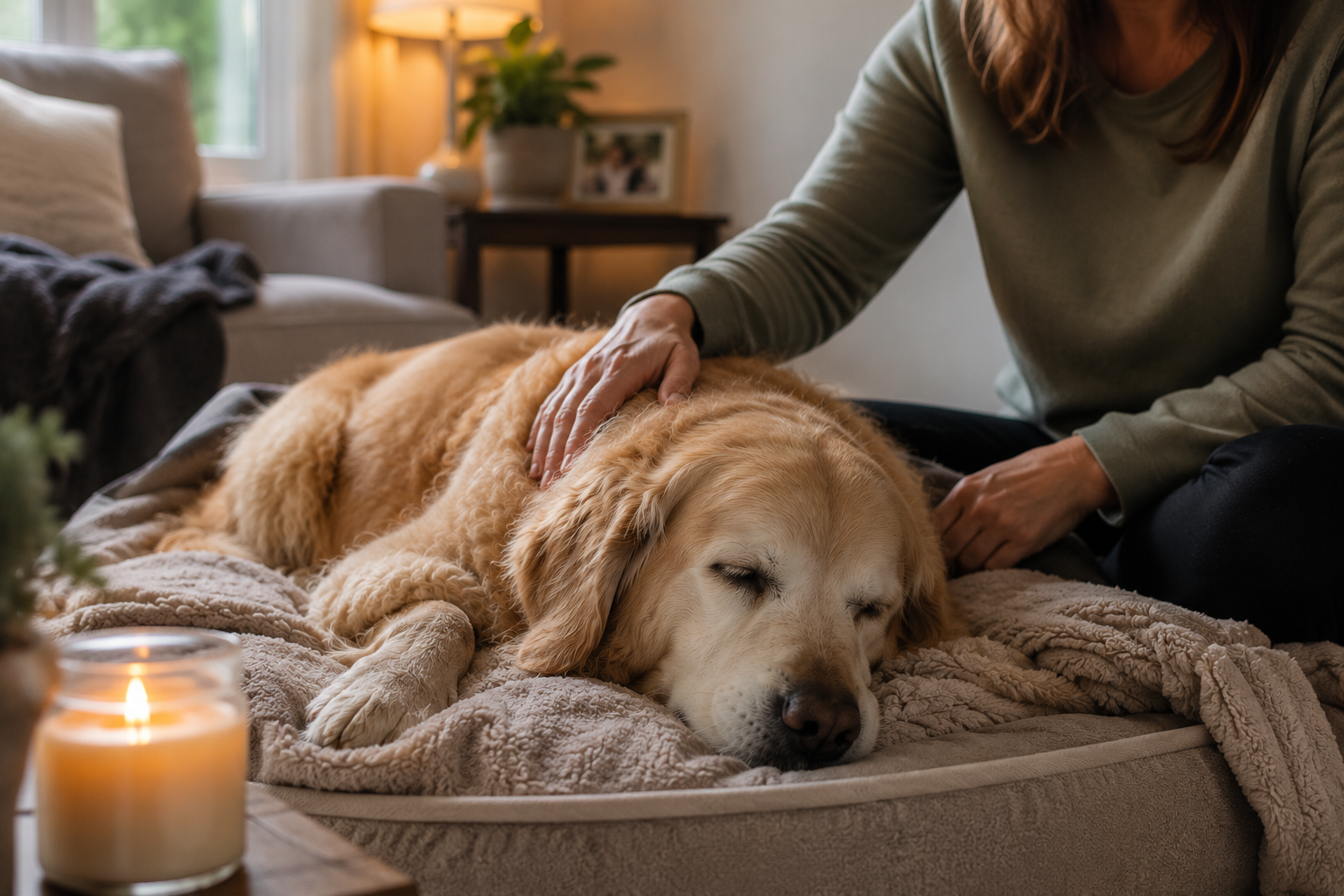
A dog that won’t settle at night is telling you something. The behaviour is not random and it is not stubbornness. It is the result of a nervous system that has not received what it needs to move into rest, whether that is sufficient physical activity, a calm wind-down period, a comfortable sleeping environment, freedom from pain, or a sense of safety in being alone.
The owners who adapt around the problem, letting the dog into the bedroom, staying up with it, ignoring it until it eventually quiets, are managing the symptom on a nightly basis. The owners who identify the cause and address it systematically are the ones who stop dealing with it at all.
Start with the most likely cause based on your dog’s specific pattern. Make one change at a time. Give it a week before evaluating whether it made a difference. Most dogs that won’t settle at night are not difficult dogs. They are dogs with an unmet need that no one has identified yet.
Sources
- https://www.akc.org/expert-advice/health/dog-sleep/
- https://www.pdsa.org.uk/taking-care-of-your-pet/looking-after-your-pet/dogs/helping-your-dog-sleep-through-the-night
- https://www.aspca.org/pet-care/dog-care/common-dog-behavior-issues/separation-anxiety
- https://www.smalldoorvet.com/learning-center/behavior/dog-sleep-problems
- https://vcahospitals.com/know-your-pet/sleeping-requirements-of-dogs

Pingback: How to Help a Dog with Separation Anxiety - DogCat-care
Pingback: How to Calm an Anxious Dog at Home: What Actually Works