Introduction
How to switch cat food without upsetting your cat’s stomach sounds like a simple question with a simple answer. Transition slowly over seven days, mix old and new in increasing ratios, done. That advice is correct for cats that accept the new food in the first place. For cats that refuse the new food entirely, pick around it, or eat less and less until they stop eating altogether, the seven-day plan is not the problem. The approach is.
Most guides on this topic stop at the standard transition schedule. This one covers what to do when that schedule fails, including a principle that most owners discover by accident and almost nobody writes about directly.
By Dogcat-Care.
Table of Contents
Why Cats Resist Food Switches More Than Dogs
Cats develop food preferences early and hold them with unusual persistence. This is not stubbornness in a behavioural sense. It is a survival mechanism. In the wild, a cat that ate a certain prey and survived learned to recognise that food as safe. Unfamiliar food carried unknown risk. The preference for familiar food is hardwired, and domestic cats retain it fully despite living in environments where unfamiliar food poses no actual threat.
This means a cat that has eaten the same food for months or years has built a strong neural association between that specific smell, texture, and taste and the concept of safe food. A new food, regardless of how nutritionally superior it is, registers as unfamiliar and therefore suspect. The cat is not being difficult. They are doing exactly what their instincts are designed to do.
The practical implication is that food switches in cats require more patience and more strategic thinking than most owners apply. The seven-day schedule works for cats with flexible food preferences. For cats with strong preferences, it is a starting point rather than a complete plan.
The Standard Transition Plan and When It Works
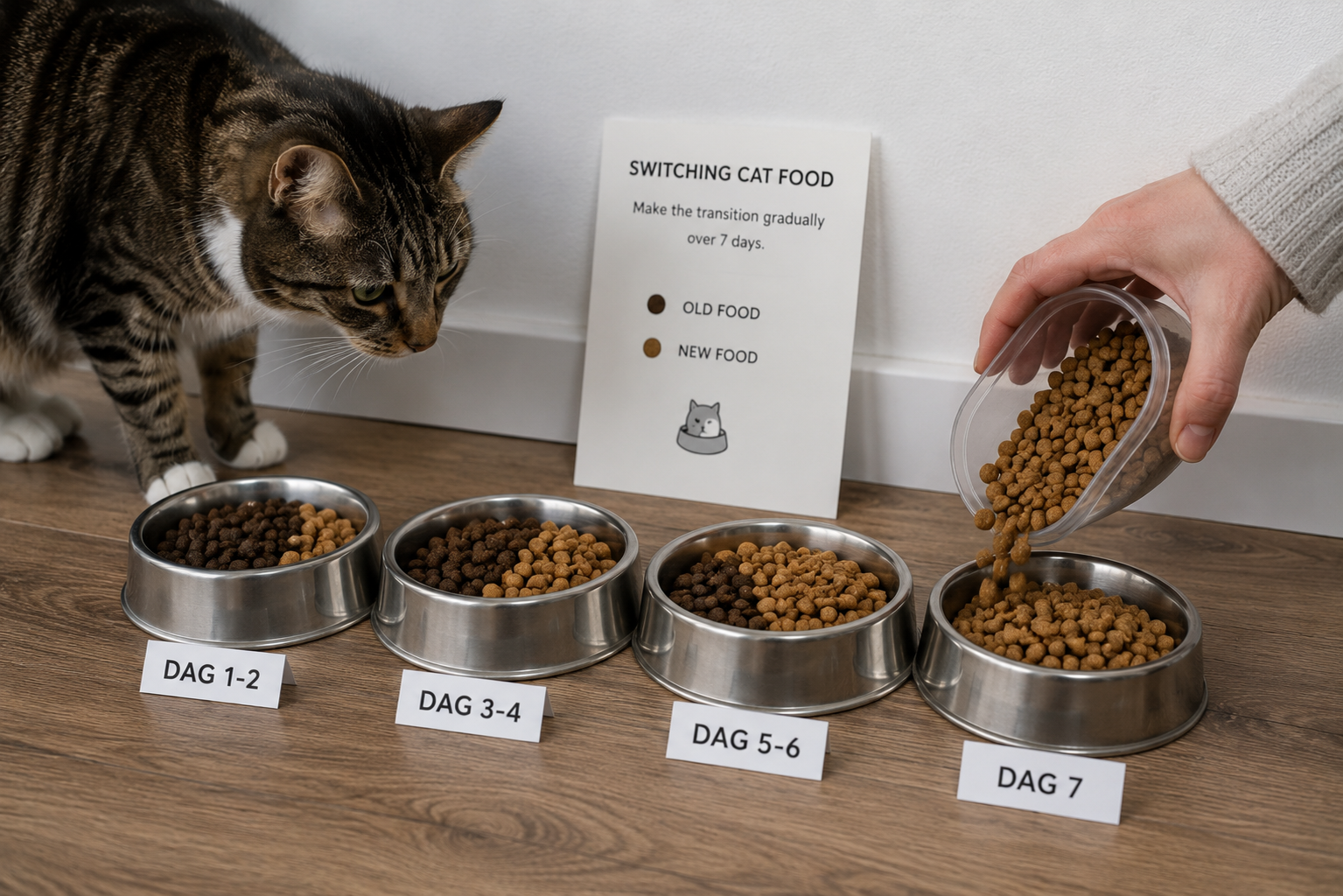
The standard approach is well established and works reliably for cats that are willing to engage with the new food at all. The schedule runs over seven to ten days and follows a progressive ratio:
Days one and two: 75% old food, 25% new food. Days three and four: 50% each. Days five and six: 25% old food, 75% new food. Day seven onward: 100% new food.
Mix the foods together rather than serving them separately. A cat given a choice between old and new food will eat the old food and ignore the new. Mixing removes the choice and means the cat encounters the new smell and taste alongside the familiar one in every mouthful.
This approach works well when the new food is in the same format as the old, wet to wet or dry to dry, and when the flavour profile is not dramatically different. A cat switching from one chicken-based wet food to another is far more likely to accept the transition smoothly than a cat switching from dry kibble to wet food for the first time, or switching to a protein they have never eaten before.
For cats with sensitive digestive systems, extend the schedule to fourteen days rather than seven. Move through the ratios more slowly and watch for loose stools or vomiting at each stage before progressing to the next ratio. If digestive symptoms appear, hold the current ratio for an extra two to three days before moving forward.
Why the Standard Plan Fails for Some Cats
The standard plan assumes the cat will eat the mixture. When a cat refuses to eat the mixed bowl, picks out the old food and leaves the new, or begins eating less overall, the transition has stalled and a different approach is needed.
The most common reason the standard plan fails is that the new food is too different in texture or smell from what the cat knows. Cats are highly sensitive to food texture. A cat that has eaten pâté-style wet food for years may refuse chunked or shredded formats regardless of flavour. A cat that has only ever eaten dry kibble experiences wet food as a completely alien substance the first time they encounter it.
The second reason is that mixing the foods allows the cat to identify and avoid the new element. Some cats are skilled at eating around the unfamiliar component in a mixed bowl. If your cat is consistently leaving portions of the mixture, they are sorting the new food out and eating around it.
The third reason is that the cat associates the new smell with the digestive discomfort that sometimes occurs during transitions. If the first few exposures to the new food coincided with loose stools or nausea, even mild nausea, the cat may have formed a negative association with the smell. This is called conditioned taste aversion and it is remarkably persistent in cats. A cat that has formed this association will refuse the new food consistently, regardless of how slowly you reintroduce it.
What to Do When Your Cat Refuses the New Food
When the standard plan has stalled, the approach needs to change before the digestive benefit of a slow transition is lost entirely.
The first adjustment is to reduce the ratio rather than hold it. If your cat is eating a 50/50 mix reluctantly or incompletely, go back to 75% old food and 25% new for several more days. The goal is to find the ratio your cat accepts without resistance and hold it there longer than the standard schedule suggests before moving forward again.
The second adjustment is to change how you introduce the new food. Instead of mixing it into the bowl, place a very small amount of the new food on a separate plate next to the regular bowl. Do not require the cat to eat it. Let them investigate it on their own terms. Some cats that refuse new food in a mixed bowl will investigate and taste it when it is presented separately and without pressure.
Warming the new food slightly increases its smell, which helps cats that are driven primarily by scent to engage with unfamiliar food. Wet food in particular becomes more aromatic at a temperature close to body heat, which approximates the smell of fresh prey. A cold wet food from the refrigerator has far less scent than the same food at room temperature or slightly warmer.
Adding a small amount of something strongly palatable on top of the new food, a teaspoon of tuna water, a small amount of the cat’s favourite broth, helps some cats take the first few bites of an otherwise refused food. The familiar top layer provides the initial engagement and the cat encounters the new food underneath. Over several days, reduce the topper as the cat becomes more comfortable with the new food on its own.
How Scarcity Changes What a Cat Will Accept
This is the principle that most owners discover by accident and almost nobody explains directly.
A cat offered three food options will develop a clear hierarchy: a favourite, a sometimes food, and a food they largely ignore. Given free access to all three, they will eat primarily the favourite and ignore the bottom of the hierarchy almost entirely. This looks like a fixed preference, and most owners treat it as one.
What changes the equation is reducing availability of the preferred options. When the favourite food becomes less frequent and the middle option becomes less available, the food that was previously ignored gets eaten. Not because the cat suddenly likes it, but because the comparison point has changed. A cat choosing between three options ranks them against each other. A cat choosing between one option and nothing chooses the one option.
This does not mean starving your cat into compliance. A cat should not go without food for more than twenty-four hours, and forcing hunger as a training tool is not appropriate. What it means is that if you are trying to transition a cat to a new food and they are consistently refusing it because preferred options are always available, reducing the availability of those preferred options changes the calculation.
In practice: if your cat has a strong favourite that they always choose over the new food, serve the new food first and do not offer the favourite until the new food has been available for a set time. If the cat does not eat the new food within thirty minutes, remove the bowl and offer the favourite. Do not leave both available simultaneously. Over days and weeks, most cats will begin engaging with the new food because the alternative is waiting.
This approach requires consistency. Offering the favourite immediately when the cat refuses the new food teaches the cat that refusal produces the preferred outcome. The lesson you are reinforcing needs to be: engaging with the new food is the path to a meal.
Switching From Dry to Wet Food: Why It Is Harder
Dry to wet is the hardest food switch a cat can go through, and it is also one of the most common because wet food is nutritionally superior for most cats. The obstacles are specific and worth addressing directly.
The first obstacle is texture. A cat that has only ever eaten dry kibble has no framework for wet food. The moisture content, the softness, and the smell are all completely unfamiliar. Some cats approach wet food with genuine curiosity. Others treat it as a foreign substance and refuse to touch it.
Start with a wet food that has the closest texture to what the cat already accepts. Pâté styles are often better for dry-food cats than chunked formats because the consistency is more uniform and easier to mix with kibble. A small amount of pâté mixed into dry food changes the texture of the kibble without making the bowl look entirely unfamiliar.
The second obstacle is smell. Dry food has a relatively mild smell compared to wet food. The stronger smell of wet food can overwhelm a cat that is not used to it. Starting with a milder wet food flavour, chicken rather than fish, for example, reduces the smell differential in the early stages of the switch.
The third obstacle is the cat’s internal sense of what a meal looks like. Cats fed dry food for years have calibrated their hunger signals around the density and volume of kibble. Wet food has far higher moisture content and lower caloric density by volume, which means a portion that looks larger than the kibble portion may contain fewer calories. Cats transitioning from dry to wet sometimes appear unsatisfied after meals during the first weeks of the transition. This settles as their internal calibration adjusts.
Understanding exactly how much wet food your cat needs relative to what they were eating before is worth working out before the switch. The guide on how much to feed a cat per day covers the caloric comparison between wet and dry food formats and gives the portion calculations by weight.
Signs the Transition Is Going Wrong
Most food transitions produce some minor digestive adjustment. Softer stools for a few days, slightly reduced appetite for the first week. These are normal and do not require intervention beyond slowing the transition pace.
The signs that indicate something is genuinely wrong are more specific. Vomiting more than once a day for two or more consecutive days is a signal to pause the transition and return to the old food entirely for several days before attempting again more slowly. Diarrhoea that is watery rather than simply soft, particularly if it persists beyond three days, warrants the same response.
A cat that stops eating entirely for more than twenty-four hours during a transition needs the old food reintroduced immediately. Cats that go without food for more than forty-eight hours are at risk of hepatic lipidosis, a serious liver condition that develops when a cat’s body begins metabolising fat stores in the absence of food intake. This is not a risk to take lightly. If your cat refuses to eat the old food after it is reintroduced, contact your vet.
Weight loss during a transition is worth monitoring. A small amount of weight fluctuation is normal. Consistent weight loss over the transition period means your cat is not eating enough of either food and the pace needs to slow significantly.
If you have recently switched your cat’s food and they have subsequently stopped eating altogether, the causes and responses are covered in the article on why your cat may not be eating.
FAQ
How long should a cat food transition take?
For most cats, seven to ten days is sufficient. For cats with sensitive stomachs, extend to fourteen days. For cats that show resistance to the new food, the transition may take several weeks of patient, consistent exposure before they accept the new food reliably.
Can I switch cat food cold turkey?
For most healthy adult cats, an abrupt switch will cause digestive upset ranging from mild to significant. It is not dangerous in itself but it is uncomfortable for the cat and it increases the risk of the cat forming a negative association with the new food. A gradual transition is always preferable unless your vet recommends otherwise for a specific medical reason.
My cat ate the new food fine for a week and then suddenly refused it. Why?
This is more common than most guides acknowledge. Some cats accept a new food initially and then reject it once the novelty wears off and they have time to compare it to their established preferences. Return to a mixed ratio temporarily, reduce the availability of preferred alternatives, and reintroduce the new food more gradually.
Should I mix wet and dry food during a transition?
You can, but mixing formats adds a texture variable on top of the flavour variable, which increases the complexity of the transition. If you are switching both format and flavour simultaneously, the transition is harder. Where possible, switch one variable at a time: new food in the same format first, then consider a format change separately.
What if my cat vomits after eating the new food?
One instance of vomiting is not necessarily a sign of a problem. Cats vomit more readily than most other animals and a single episode during a food transition is not unusual. If vomiting occurs more than once a day or on consecutive days, pause the transition and return to the old food for several days before trying again at a slower pace.
Is it bad to keep switching cat food?
Switching too frequently, before the cat’s digestive system has adjusted to each new food, causes repeated digestive disruption and makes it harder for the cat to develop stable eating patterns. That said, a cat eating the same food for years with no variety can develop strong preferences that make any future switch significantly harder. Introducing occasional variety within a stable diet, rather than frequent complete switches, is the more balanced approach.
Final Thoughts
How to switch cat food without upsetting your cat’s stomach is partly about the transition schedule and partly about understanding what drives a cat to refuse new food in the first place. The standard seven-day plan works when the cat is willing to engage with the new food. When they are not, the response is not to push harder but to change the approach.
Reduce the ratio rather than hold it when resistance appears. Change the presentation before concluding the cat will never accept the new food. Use scarcity strategically: a cat with constant access to a preferred option has no reason to engage with an unfamiliar one. And if you are switching from dry to wet food, expect the transition to take longer and start with the format and flavour closest to what your cat already knows.
If your cat’s resistance to new food has led you to question whether the food you are switching to is the right choice in the first place, the breakdown of nutritional quality and what to look for in a cat food is covered in the guide to best cat food for indoor cats.
Sources
- https://www.petmd.com/cat/nutrition/how-to-switch-cat-food
- https://www.purinainstitute.com/centresquare/understanding-pet-food/switching-pet-foods-cats
- https://vcahospitals.com/know-your-pet/hepatic-lipidosis-in-cats
- https://www.merckvetmanual.com/digestive-system/hepatic-diseases-in-small-animals/hepatic-lipidosis-in-cats